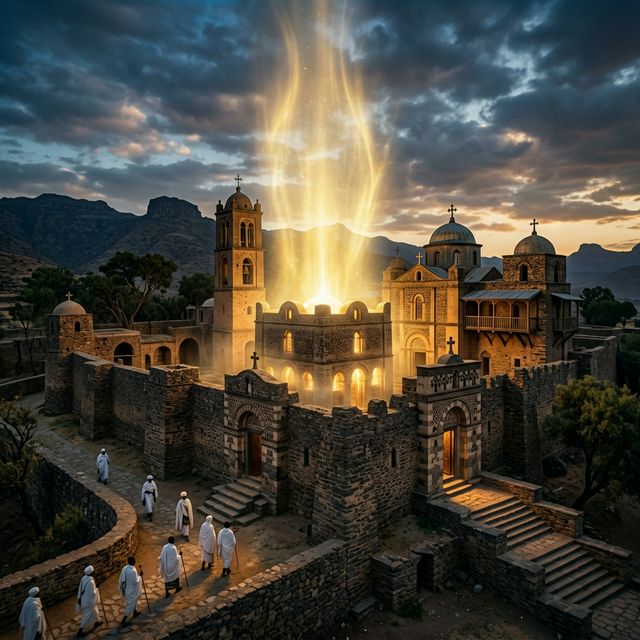
In the high, rugged mountains of East Africa lies a nation with a spiritual identity unlike any other on earth. Ethiopia, or ancient Abyssinia, remains the only African nation never to be fully colonized, a feat many Ethiopians attribute not just to their warrior spirit, but to a divine guardianship. At the heart of this identity is a mystery that has captivated the world for millennia: the presence of the Ark of the Covenant.
The Solomonic Legacy: A Kingdom Born of Wisdom
The story begins in the 10th century BC with the legendary meeting between King Solomon of Israel and the Queen of Sheba, known in Ethiopia as Makeda. According to the Kebra Nagast (The Glory of the Kings), their union produced a son, Menelik I, who would become the first Emperor of Ethiopia.
When Menelik traveled to Jerusalem to meet his father, he did not return alone. Tradition holds that he brought with him the Ark of the Covenant—the golden chest containing the Ten Commandments—transporting the very presence of God from the Temple of Solomon to the highlands of Ethiopia. This event transformed Ethiopia into a "New Israel," a chosen nation with a sacred mission to protect the holiest relic in Christendom.
The Aksumite Empire: A Beacon of Early Christianity
By the 4th century AD, under King Ezana, the Aksumite Empire became one of the first nations in the world to officially adopt Christianity. While the rest of the world saw the rise and fall of empires, Ethiopia’s Christian identity remained a bedrock. The landscape is dotted with evidence of this deep faith, from the monolithic rock-hewn churches of Lalibela to the towering stelae of Axum.
- St. Mary of Zion: The spiritual heart of the Ethiopian Orthodox Church, where the Ark is said to reside.
- Monastic Tradition: A rich history of desert fathers and isolated monasteries preserving ancient manuscripts.
- Ge'ez Script: One of the oldest living liturgical languages, used to transmit the Gospel for nearly 2,000 years.
The Battle of Adwa: Unconquerable Faith
The title "The Unconquerable Kingdom" was earned in 1896 at the Battle of Adwa. When the Italian army attempted to colonize Ethiopia, they were met by a unified force led by Emperor Menelik II and Empress Taytu Betul. Carrying the Tabot (consecrated replicas of the Ark) into battle, the Ethiopian forces achieved a decisive victory.
For Ethiopia, Adwa was more than a military triumph; it was a divine validation. It solidified the belief that as long as the Ark remained in Ethiopia, the nation would remain free. This victory turned Ethiopia into a symbol of resistance and hope for the entire African continent and the African diaspora.
The Chapel of the Tablet: A Sacred Mystery
Today, the Ark is said to be kept in a small chapel in Axum, guarded by a single monk who never leaves the compound. No one else, not even the Patriarch of the Church, is permitted to see it. While skeptics search for historical "proof," for millions of believers, the proof is in the enduring survival and unique spiritual depth of the Ethiopian people.
Theological Significance: The Ark as Divine Presence
In the Ethiopian Orthodox Tewahedo Church, every church is centered around a Tabot. The Ark is not just a historical artifact; it is a living symbol of God’s covenant and presence among His people. It bridges the gap between the Old and New Testaments, showing a continuity of faith that has remained unbroken for three thousand years.
Key Scriptures to Reflect On
- Psalm 68:31 — "Envoys will come from Egypt; Ethiopia will quickly stretch out her hands to God."
- Isaiah 18:7 — A prophecy regarding the people of Ethiopia bringing gifts to the Lord of hosts.
- Acts 8:26-40 — The story of the Ethiopian eunuch, representing the early spread of the Gospel to Africa.
Conclusion
Ethiopia stands alone as a testament to the power of a faith-rooted identity. By weaving together the legacy of Solomon, the mystery of the Ark, and a history of fierce independence, it offers a unique window into the "Unconquerable Kingdom." Whether the Ark sits in a chapel in Axum or lives in the hearts of the faithful, its impact on history is undeniable.
"Ethiopia is not just a place on a map; it is a spiritual fortress, where ancient promises continue to breathe in the mountain air."